
For most of the world, Tuscany is Florence: Renaissance domes, soft hills in the background, galleries filled with masterpieces. But step just beyond the city limits, and the region opens into five areas that reveal another Tuscany, Chianti, Val d’Orcia, Val di Chiana, the Aretino and Mugello, each with its own geography, history and pace.
For travel advisors researching unique experiences in Italy, these areas offer a way to build itineraries that go beyond the icons, drawing on landscapes, art and local traditions that have shaped this part of Tuscany for centuries. What follows is a closer look at each one: where it sits on the map, which towns anchor it, and what makes it worth a place in a client’s itinerary.
Chianti, between Florence and Siena
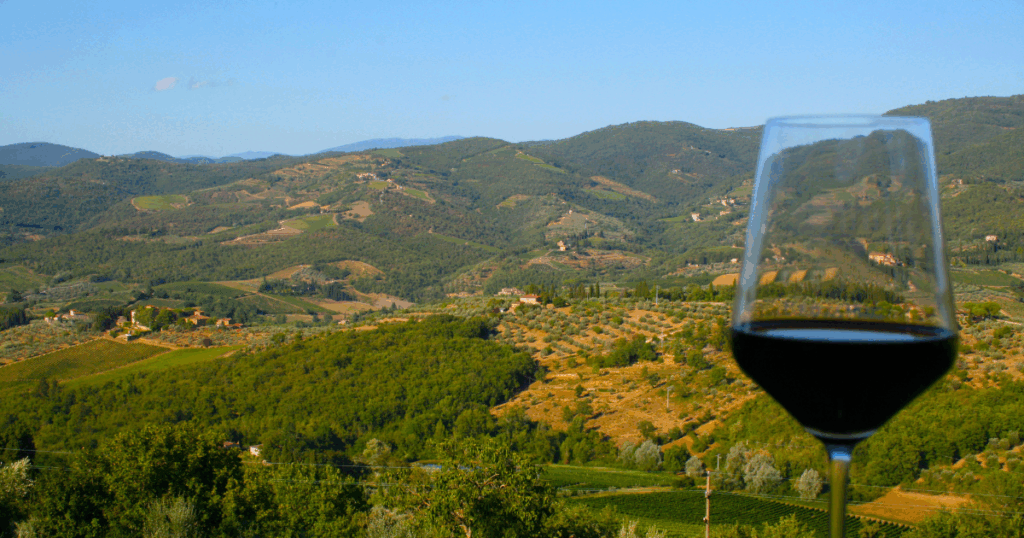
Chianti lies between Florence and Siena, its vineyard hills anchored by four small towns, Greve in Chianti, Radda in Chianti, Castellina in Chianti and Gaiole in Chianti, together known as Chianti Classico. In 1384, these communities banded together as the Lega del Chianti, bound less by treaties than by the simple need to survive centuries of rivalry between Florence and Siena.
That same rivalry is where the region’s black rooster comes from, still stamped on every Chianti Classico label today. As the story goes, the two cities once agreed to settle a border dispute with a race: two knights, one from each side, would ride out at the crow of a rooster, and wherever they met would become the new line. Florence chose a black rooster and, legend says, kept it hungry in the dark until it screamed for dawn hours early, giving its rider a head start Siena never recovered from. Whether it happened quite like that or not, the story still gets told over a glass of wine in Chianti’s cellars, and it is hard not to smile at a border decided by a hungry bird.
Wine is still what carries a visit here, less a single stop than a mood that follows you from one cellar to the next.
Val d’Orcia, a Renaissance landscape south of Siena
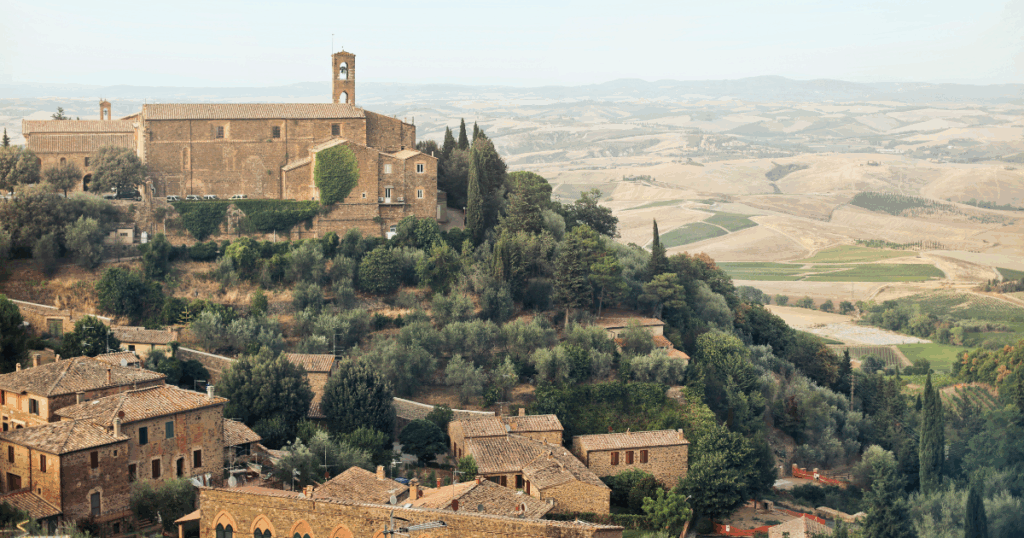
South of Siena, Val d’Orcia is held together by Pienza, Montalcino and Castiglione d’Orcia, and in places it still looks almost exactly as it did five centuries ago. That is not an accident. In 1459, a young Pope who had been born in this same small village, Pius II, decided he wanted to remake it in his own image, an ideal Renaissance town rather than the medieval hamlet he grew up in. He gave the job to architect Bernardo Rossellino, and the result, the trapezoidal Piazza Pio II, still sits at the heart of Pienza, more elegant than a papal whim has any right to be.
For clients, the valley itself does the rest of the work: horseback rides through open fields, vintage car tours along roads that curve exactly where the cypress trees do, and the natural mineral springs of Bagni San Filippo, where centuries of deposits have quietly built up pools and a pale, almost ghostly formation locals call the whale.
Val di Chiana, from the Etruscans to today
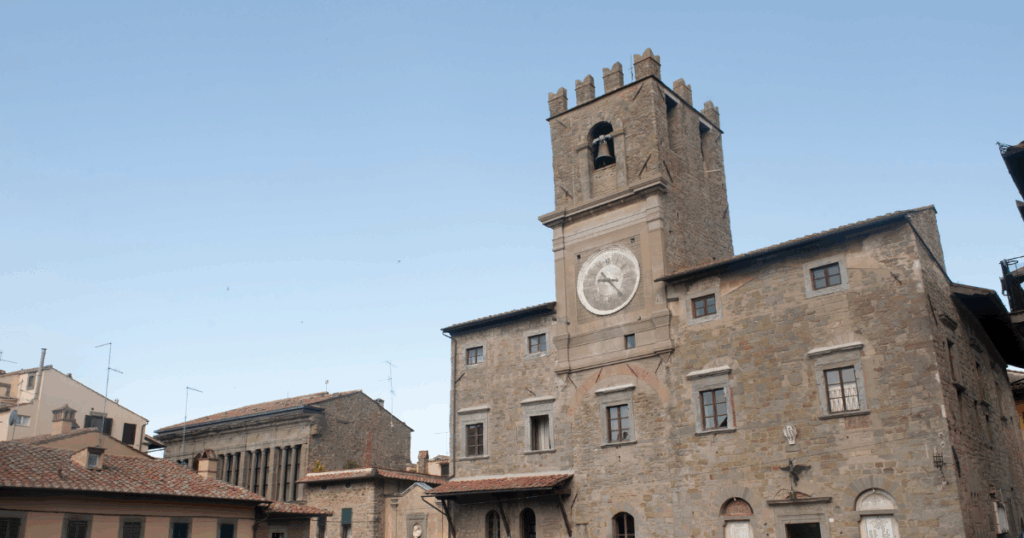
Val di Chiana stretches between the provinces of Arezzo and Siena, right up to the border with Umbria, and its most storied town, Cortona, has been drawing visitors for a lot longer than tourism has existed as a concept. Long before it became a hilltop escape, Cortona was a powerful Etruscan city, and its MAEC museum still holds the Tabula Cortonensis, one of the longest Etruscan inscriptions ever found, a text nobody has fully deciphered even now. Just outside town, two burial mounds known as the Meloni del Sodo rise quietly from the fields, the way things nearly three thousand years old tend to.
Nearby, Civitella in Val di Chiana has stayed mostly untouched by mass tourism, and Lucignano is laid out in an odd, beautiful pattern, elliptical rings of streets that make getting a little lost feel like part of the plan. For clients drawn to wellness, San Casciano dei Bagni offers its own thermal waters, while the Sentiero della Bonifica trail lets those who prefer walking trace the valley on foot, from Arezzo down to the lake of Montepulciano.
The Aretino, genius around Arezzo
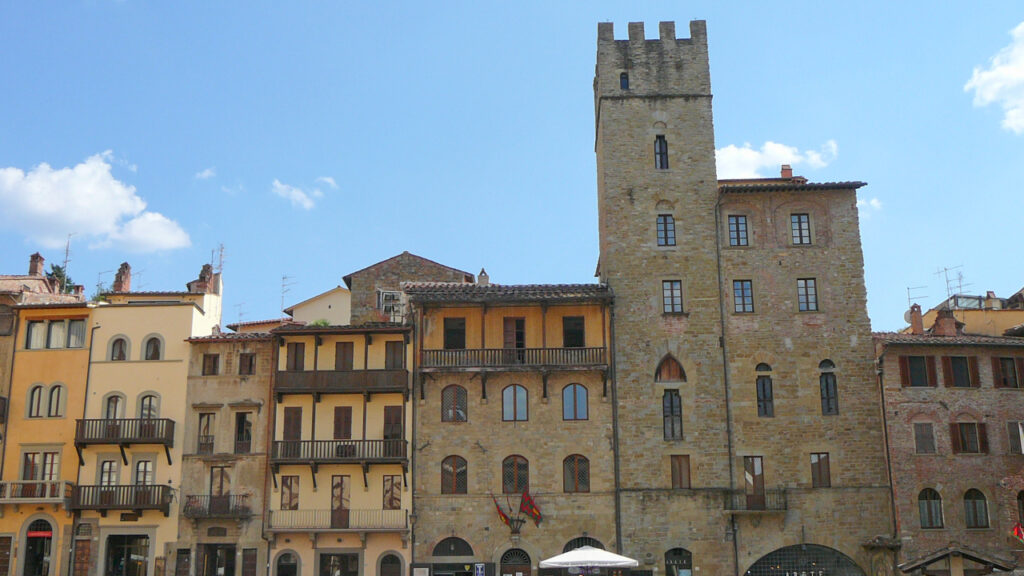
Arezzo sits on Tuscany’s eastern edge, close enough to Umbria to feel the border, and it has quietly produced more talent per square meter than a lot of better known towns. Francesco Petrarca was born here in 1304, and inside the Basilica di San Francesco, Piero della Francesca spent over a decade, from 1452 to 1466, painting The Legend of the True Cross, a fresco cycle still considered one of the great achievements of the early Renaissance.
Twice a year, the same square that hosts a well loved antiques market on the first Sunday of every month turns into something else entirely: Piazza Grande fills with armor and horses for the Giostra del Saracino, a jousting tournament first recorded in 1260 and brought back to life in 1931, close enough to its medieval roots to still feel a little dangerous. Casa Vasari, once home to painter and architect Giorgio Vasari, is now a museum, and the frescoes on its walls are his own, painted for himself rather than a client.
Within easy reach of Chianti, Cortona and Montepulciano, the Aretino makes a natural base for a longer stay.
Mugello, art and motorsport north of Florence
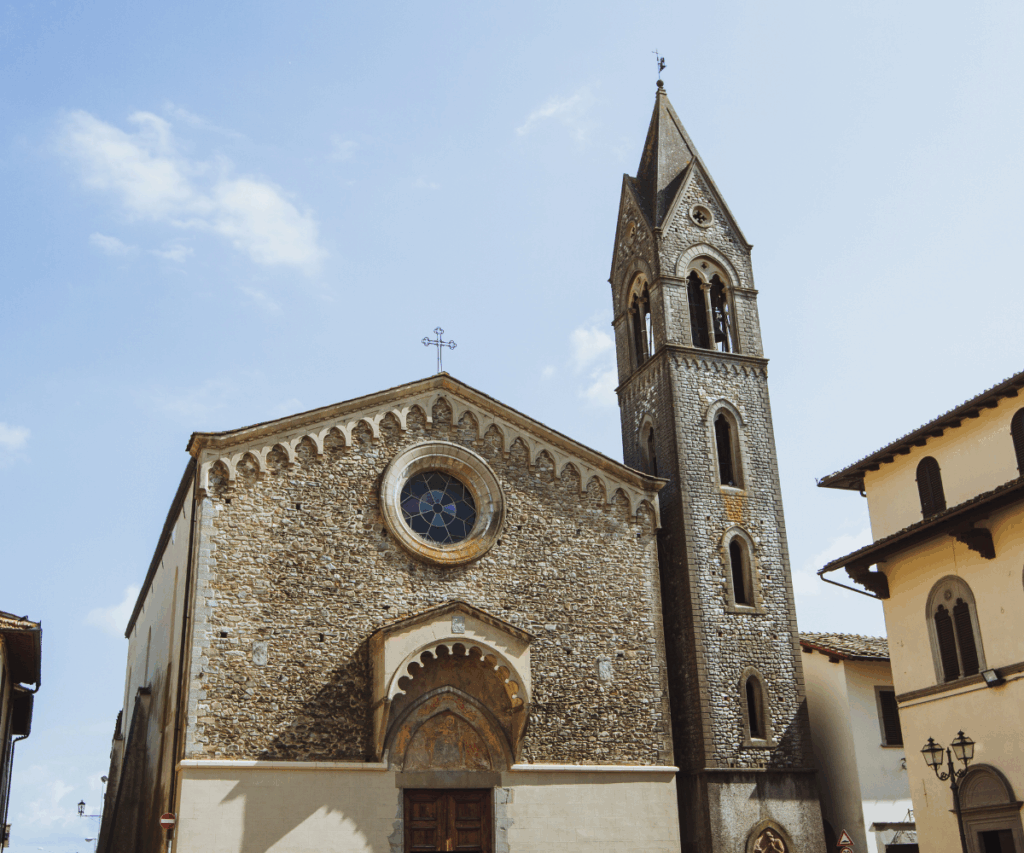
North of Florence, toward the border with Emilia-Romagna, Mugello is built around towns like Borgo San Lorenzo, Vicchio and Scarperia e San Piero, and it has a habit of producing people who changed how Italy sees itself. Giotto was born here around 1266, at Colle di Vespignano near Vicchio, and about a century later Beato Angelico, known to English speakers as Fra Angelico, was born just down the road in Rupecanina. Look at their paintings and it is not hard to guess where the light comes from.
Scarperia carries its own kind of craftsmanship: the town has been making knives by hand for centuries, and its blacksmiths are still regarded as some of the finest in Italy, a tradition clients can see up close in workshops that have barely changed in generations. A short drive away, Scarperia e San Piero is also home to the Autodromo Internazionale del Mugello, a Ferrari owned racetrack that hosts the Italian motorcycle Grand Prix and pulls in MotoGP fans from well beyond Tuscany, proof that this quiet corner of the region can still make plenty of noise.
Away from the track, private truffle hunts and tastings at family run wineries offer a slower introduction to the area, and by autumn, the countryside around Marradi turns into its own destination, known for foraged chestnuts and porcini mushrooms.
Conclusion
Tuscany is Florence, but it is also much more. The five areas covered here can complete an itinerary built around this iconic city, each adding something different to the story. Whether it is a wine tasting in the hills of Chianti or a walk through the stone streets of a town like Cortona or Arezzo, clients will find a richness of landscapes, flavors, views and historical references that only this region can offer.s already experienced Italy’s most photographed coastlines, they offer a way to keep discovering the country.
Let’s collaborate on your next luxury Italy tour.